THE LEGAL GAZETTE | DETAILED NEWS REPORT | NOVEMBER 2026
THE LEGAL GAZETTE | DETAILED NEWS REPORT | NOVEMBER 2026
Centre Revises PUC Certificate Validity; New BS-VI Private Vehicles to Get Up to Three Years’ Validity.Central Motor Vehicles (Sixteenth Amendment) Rules, 2026 introduce age-based renewal schedule; older vehicles to undergo more frequent pollution certification
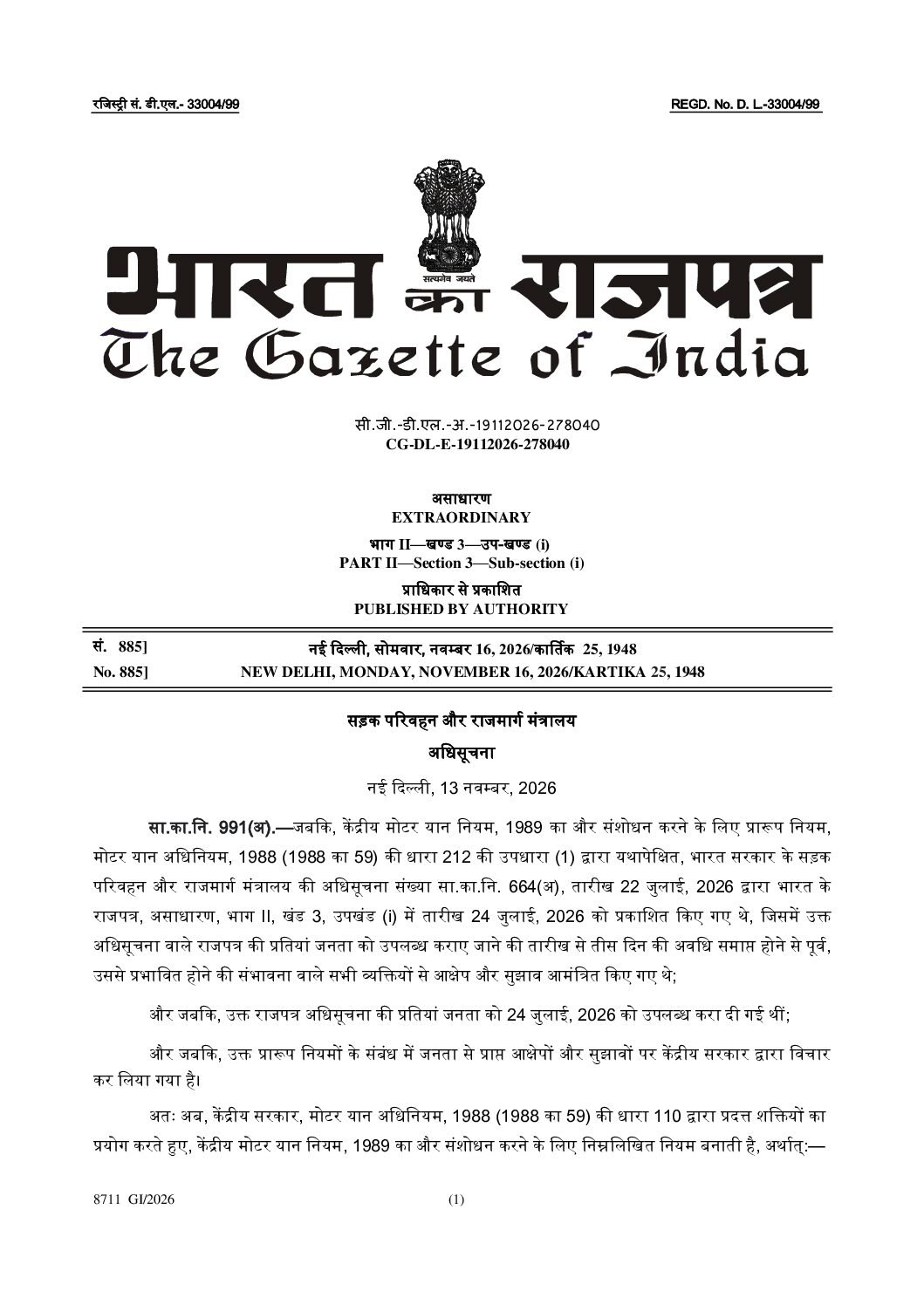
NEW DELHI: In a significant regulatory change concerning vehicle-emission compliance, the Ministry of Road Transport and Highways (MoRTH) has notified the Central Motor Vehicles (Sixteenth Amendment) Rules, 2026, revising the validity periods of Pollution Under Control (PUC) certificates across different categories of motor vehicles.
The amendment further modifies the Central Motor Vehicles Rules, 1989, by substituting Rule 115(7) and inserting a new Rule 115(7A). The revised framework links the validity of PUC certificates to three principal factors: the vehicle’s Bharat Stage emission standard, its classification as a transport or non-transport vehicle, and its age calculated from the date of first registration.The notification was issued under G.S.R. 991(E), dated 13 November 2026, in exercise of the powers conferred under Section 110 of the Motor Vehicles Act, 1988. The amendment came into force upon publication in the Official Gazette.
New validity schedule: Vehicle-wise classification
Under the newly inserted Rule 115(7A), the revised validity periods are prescribed as follows:
| Emission category | Vehicle classification | PUC validity |
| BS-I, BS-II and BS-III | All motor vehicles | 3 months |
| BS-IV | All motor vehicles | 6 months |
| BS-VI | Non-transport, up to 6 years | 3 years |
| BS-VI | Non-transport, above 6 to 10 years | 1 year |
| BS-VI | Non-transport, above 10 years | 6 months |
| BS-VI | Transport, up to 6 years | 2 years |
| BS-VI | Transport, above 6 to 10 years | 1 year |
| BS-VI | Transport, above 10 years | 6 months |
The age of a BS-VI vehicle is calculated from its date of first registration, as expressly specified in the notification. E-Gazette
Longer validity for newer BS-VI private vehiclesOne of the most significant features of the amendment is the extension of PUC certificate validity for newer BS-VI non-transport vehicles.Under the revised schedule, BS-VI non-transport vehicles up to six years old will receive PUC certificates valid for three years. This is a substantial change from the earlier, shorter renewal cycle.
Vehicles exceeding six years but not exceeding ten years will require renewal once every year. Once a vehicle crosses ten years of age, the certificate validity will be reduced to six months.The provision covers the non-transport category, which includes privately registered cars and two-wheelers, subject to their applicable vehicle classification and emission standard.Separate renewal schedule for commercial vehicles. The amendment also provides a distinct validity schedule for BS-VI transport vehicles.
BS-VI transport vehicles up to six years old will have PUC certificates valid for two years. Vehicles above six years but not exceeding ten years will require annual renewal, while those exceeding ten years will require certification every six months.The distinction between transport and non-transport vehicles is particularly relevant during the first six years of registration. Thereafter, both categories follow the same annual and half-yearly renewal intervals.Existing PUC certificates will remain valid until expiry. The amendment contains an important transitional safeguard for vehicle owners who already hold valid PUC certificates.
Under the proviso inserted in Rule 115(7A), the revised validity schedule will apply to certificates issued before commencement only upon their first renewal after the amendment comes into force.
Consequently, existing certificate holders are not required to obtain a fresh PUC certificate merely because the amended rules have been notified. Their existing certificates continue according to their respective validity periods.
For example, if a BS-VI private vehicle has an existing PUC certificate expiring in December 2026, the owner must follow the existing expiry date. The new three-year validity schedule will be considered at the first renewal after commencement, subject to the vehicle’s age and classification.
Ten-day renewal window: An important compliance provision. The amendment also introduces a specific provision governing the effective date of renewed PUC certificates.
Under the second proviso to Rule 115(7A):
If renewal is sought within the ten days preceding the expiry date, the renewed certificate will take effect from the expiry date of the existing certificate.If renewal is sought after the expiry date, the renewed certificate will take effect from the actual date of renewal.This provision is important because it clarifies how the validity of a renewed certificate is calculated and prevents a gap in the certificate period where renewal is undertaken within the prescribed ten-day window.Vehicle owners should therefore monitor their expiry dates and avoid delaying renewal beyond the prescribed period. E-Gazette
Legal background: Sections 110 and 212 of the Motor Vehicles Act, 1988. The amendment has been framed by the Central Government in exercise of its rule-making powers under Section 110 of the Motor Vehicles Act, 1988.The notification also records that the draft amendment was previously published through G.S.R. 664(E), dated 22 July 2026, in the Gazette of India dated 24 July 2026, as required under Section 212(1) of the Act.
The draft rules invited objections and suggestions from persons likely to be affected. The notification expressly states that the objections and suggestions received were considered by the Central Government before finalisation.
The final rules were notified as G.S.R. 991(E), dated 13 November 2026, and published in the Gazette of India on 16 November 2026.Impact on vehicle owners and enforcement authorities. The revised framework is expected to reduce the frequency of PUC renewal visits for owners of newer BS-VI vehicles. At the same time, it retains more frequent certification requirements for vehicles operating under older emission standards and ageing BS-VI vehicles.
For enforcement authorities, the substituted Rule 115(7) continues to require every motor vehicle to carry a valid PUC certificate issued or renewed by an agency authorised by the State Government. Such certificates must be produced on demand before officers specified under Rule 116(1) of the Central Motor Vehicles Rules, 1989.
The amendment changes the prescribed validity period; it does not abolish the statutory requirement to maintain a valid PUC certificate.What vehicle owners should check
The Bharat Stage emission category of their vehicle.The date of first registration.Whether the vehicle is registered as transport or non-transport.The expiry date of the existing PUC certificate.The revised validity period applicable at the first renewal after commencement.Gazette reference and statutory particulars
THE LEGAL GAZETTE
Editorial Perspective
The Sixteenth Amendment represents a shift towards an age-based and emission-standard-based PUC certification framework. By extending the validity period for newer BS-VI non-transport vehicles while retaining shorter renewal cycles for older vehicles, the amendment introduces a differentiated approach to regulatory compliance.Its implementation will be significant for vehicle owners, transport operators, authorised PUC testing centres and traffic enforcement authorities across the Country.
Editorial note: This report is based on the published Gazette notification. The Gazette issue date is 16 November 2026, while the notification itself is dated 13 November 2026. These dates should be distinguished in all subsequent citations and publications.











Post Comment